This was originally published in November 2025 on a previous iteration of this site.
On occasion, I talk about my own permaculture site. Sometimes I am hesitant to do so, because it is my sanctuary, and my place to learn and make mistakes. Some permaculturists who focus on expensive structural systems and more traditional aesthetics shaped by heavily populated European city culture deemed it “nothing special.” This opinion was negated at the Advanced Design Course in Chicagoland recently.
I started my description of my system by showing the conversion of my front yard to active growing space—the changes that took place year after year as beds were designed and implemented in keeping with the overall design of working with the surface water moving over the land. I show them the water catchment (limited though it might be). We talk about the zone 0 improvements accomplished—and those that are planned if the opportunity arises to implement them. But it is the garden which is the real focal point.
My system really began in 2006. The image from 2014 that I show most often (or really any year after 2010) is of what I now lovingly call the “Wall of Green.” Sometimes when I show one of these images, people say it looks wild, or too crazy for their own spaces. They see a “wall of green.” I understand. In my designs, I’m more sensitive to spacing, more traditional aesthetics, and the likely needs of considering the neighbors’ opinion. We are all at different levels of tolerance for “wildness.” Personally, I love it! Wildness is not chaotic. There is an emerging order. It is our teacher and the species which incorporate into the system are friends and allies for the most part. And this is what I shared with my students this year.
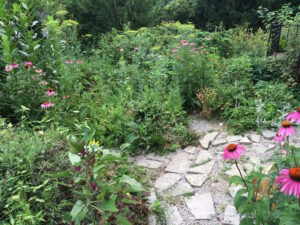
One PDC student in March pointed out that I should contrast the June/July pictures I love of full foliage and the flowers of that moment with the emerging plants of March or the dying back in October. Then, people could see the stone-edged beds, the pathways, and the structure of my tended perennials which give structural order to our growing spaces. It does help to convey the design in working with nature. Each stone, each bed shape is placed in response to the flow of water, the need to protect and hold soil, the shape and size of the plants that are growing in the spaces.
The Advanced Design students got to see the progression of the seasons from spring emergence to summer fullness and back to fall/winter drawing in. As I shared the story of the landscape, I talked to them about the natural flow of birds, insects, and plants across the spaces. How chickweed comes as a ground cover, vegetable, and medicine, into which tomatoes and peppers are planted. When the chickweed (which I didn’t plant) dies back, sweet potatoes take over as ground cover—to grow until first frost—when a light mulch covers the soil for the winter and kale and chard are planted in—awaiting the turn of the cycle.
As we came to the June/July/August images, I was nervous about showing them the “Wall of Green.” When we came to it, I started naming the species I saw: echinacea, goumi, kale, meadowsweet, broccoli, dill, currants, milkweed, tomatoes, peppers, basil, potatoes, sweet potatoes, oregano, rosemary, strawberries, raspberry (three varieties), sorrel, comfrey, dock, carrots, onions, garlic, goji, New Jersey tea, ground cherry*, asparagus, peach, mulberry, lilac, iris, hydrangea, holly, ramps, blueberry (four varieties), fern, horseradish, beans, various mints, lamb’s quarter, and probably several more. I talked about the cycles of the insects and birds (There are generations of catbirds that have been coming to nest, for example) and the quality of my soils as they developed. We talked about the shady back yard, which is still full of hazelnuts, raspberries, pawpaws, hackberry (bird-brought), and many other things. It’s a place we practice primitive skills, start seeds in our hoop house, and observe. The students commented that my relationship with my land is remarkable—and laudable.
I thought about it. Relationship. That is the whole point—to reintegrate ourselves with the natural world is one of the key aims of permaculture design. I still have a long way to go on my dependencies on the extraction economy. I don’t have solar panels or an expensive water tank. I’m still dependent on natural gas. We forage most of what is ripe at any point, without storing more than some seeds and a few dried, frozen, or canned items. But a fellow teacher told me later, “You did this with limited means. This is what permaculture will look like for most of us. It’s about relationship.”
Yes-it-is! Here’s to many more of us working on that relationship with Nature!
- These plants are all expansive and self-maintaining in the garden now. I didn’t anticipate all of that.
